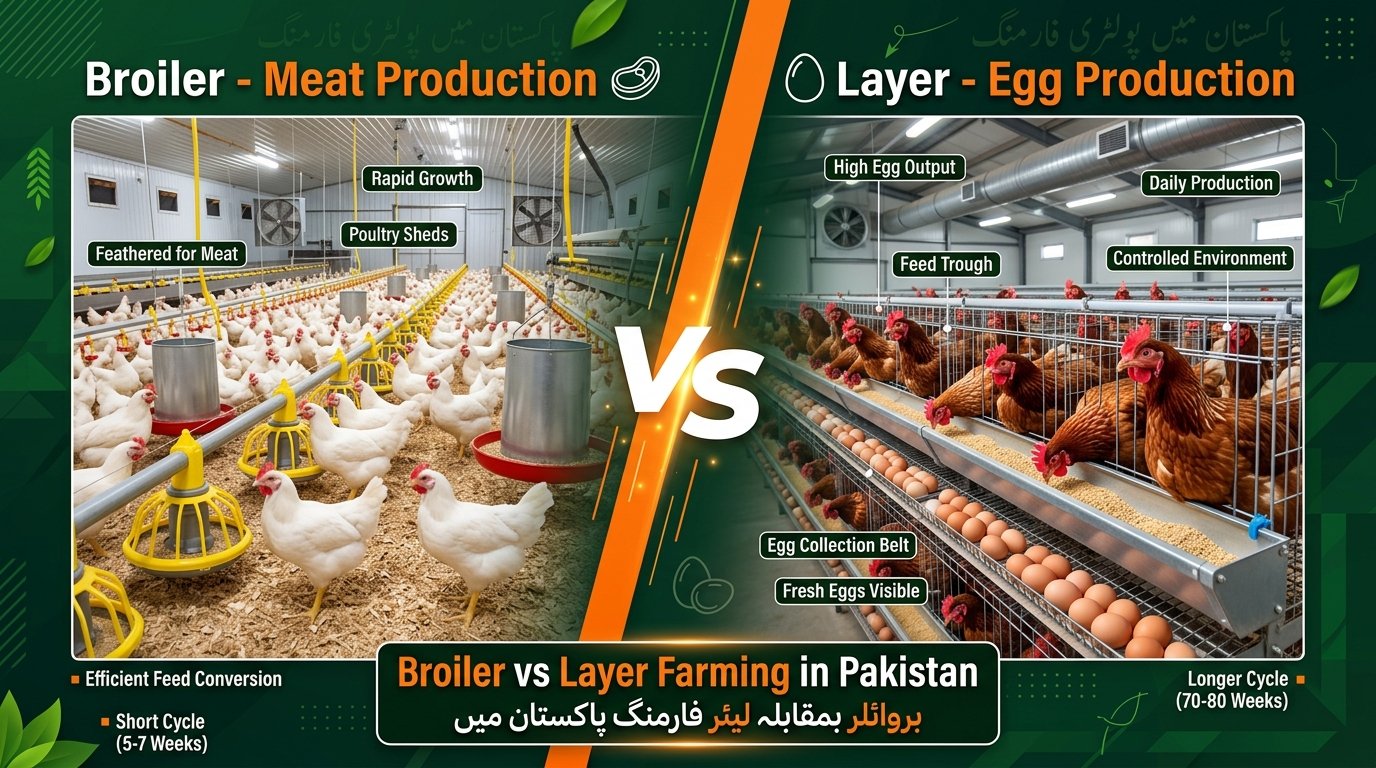
Pakistan is the 3rd largest poultry producer in Asia, with a sector worth over PKR 1.5 trillion annually and employing more than 1.5 million people directly. For anyone considering entering this industry — whether a small landowner in Punjab or an investor in KPK — the most fundamental decision is: should I raise broiler chickens (for meat) or layer hens (for eggs)? This guide gives you the complete, data-backed answer.
1. What is Broiler Poultry Farming in Pakistan?
Broiler poultry farming is the commercial rearing of fast-growing meat chickens (Gallus gallus domesticus — Cobb 500, Ross 308, Hubbard strains) bred exclusively for rapid body weight gain. A commercial broiler chick reaches market harvest weight of 1.8 kg to 2.4 kg in just 30 to 38 days — one of the fastest food-to-table conversions in the protein industry.
In Pakistan, broiler farming is the backbone of the poultry sector. The daily live broiler chicken prices that consumers check every morning — whether in Lahore, Karachi, or Islamabad — are determined by broiler supply and demand in the wholesale mandi network.
Key Characteristics of Broiler Farming
- Production purpose: Meat (white broiler chicken)
- Grow-out period: 30–38 days (5–5.5 weeks)
- Harvest weight: 1.8 kg – 2.4 kg live weight
- Feed Conversion Ratio (FCR): 1.65 – 1.85 (kg feed per kg of body weight gain)
- Common breeds in Pakistan: Cobb 500, Ross 308, Hubbard Classic
- Revenue model: Per-batch lump-sum sale to mandi commission agents
- Cycles per year: 5 to 6 batches (including 7–10 days litter cleanout between flocks)
- Primary farming belts: Faisalabad, Okara, Sheikhupura, Sialkot, Gujranwala (Central Punjab)
2. What is Layer Poultry Farming in Pakistan?
Layer poultry farming involves rearing female hens specifically selected and bred for high-volume egg production over an extended laying cycle. Unlike broilers, layer hens are not sold for meat during their productive life — they are maintained for 72 to 80 weeks (approximately 16 to 18 months) before being sent to the spent hen market.
A high-performing layer hen breed can produce 300 to 320 eggs per year, making egg farming a high-volume, longer-cycle business with daily cash flow but larger upfront investment and a more complex management model than broilers.
Key Characteristics of Layer Farming
- Production purpose: Eggs (table eggs for retail/wholesale)
- Laying cycle: 18–20 weeks (pullet rearing) + 72–80 weeks (production)
- Peak production age: 24–30 weeks (hen-day production: 90%–96%)
- Annual egg output: 300–320 eggs per hen per year (high-performance strains)
- Common breeds in Pakistan: Lohmann Brown, Hy-Line Brown, Novogen White, ISA Brown
- Housing system: Battery cages (conventional cages, enriched cages) or free-range
- Revenue model: Daily egg production sold to wholesale egg dealers (anda mandi)
- Primary farming belts: Rawalpindi, Chakwal, Attock, Gujar Khan, parts of KPK (Nowshera, Mardan)
3. Broiler vs Layer: Key Differences at a Glance
The table below provides a direct comparison across all critical dimensions for Pakistani farmers considering either farming model:
| Parameter | 🐔 Broiler Farming | 🥚 Layer Farming |
|---|---|---|
| Primary Output | Chicken meat (live bird) | Table eggs |
| Production Cycle | 30–38 days per batch | 18–20 months total |
| Setup Capital | Lower (PKR 8L–20L) | Higher (PKR 25L–80L+) |
| Cash Flow | Lump sum every ~42 days | Daily egg revenue |
| Batches Per Year | 5–6 batches | ~1 flock per 20 months |
| FCR (Feed Efficiency) | 1.65–1.85 kg feed/kg gain | 1.8–2.1 kg feed/12 eggs |
| Market Risk | High (daily price swings) | Moderate (seasonal dips) |
| Disease Risk | Moderate (short exposure) | Higher (longer exposure) |
| Management Complexity | Moderate | High |
| Break-even Period | 2–4 batches (3–6 months) | 8–14 months |
| Best For | Beginners, small capital | Experienced, higher capital |
4. Investment & Setup Cost Comparison in Pakistan (2024–2025)
Capital requirements differ significantly between the two models. Here is a realistic cost breakdown based on a 1,000-bird capacity shed in Central Punjab:
🐔 Broiler Farming Setup Costs (1,000 Birds, 2024)
| Cost Item | Estimated Cost (PKR) |
|---|---|
| Shed construction (1,000 sq ft semi-open litter) | 4,00,000 – 6,00,000 |
| Nipple drinkers & pan feeders (equipment) | 80,000 – 1,50,000 |
| Exhaust fans & curtain ventilation | 60,000 – 1,20,000 |
| Day-old chicks (DOC) — 1,000 × Rs. 90–120 | 90,000 – 1,20,000 |
| Feed (per batch ~1.8 kg FCR): 1,800 kg @ Rs. 160/kg | 2,88,000 |
| Medicines, vaccines, vitamins | 25,000 – 40,000 |
| Litter material (rice husk/wood shavings) | 15,000 – 25,000 |
| Labour (family or 1 worker per 5,000 birds) | 15,000 – 30,000 |
| Generator / electricity / water | 20,000 – 35,000 |
| Total Per Batch (Variable Costs Only) | ~4,50,000 – 5,30,000 |
🥚 Layer Farming Setup Costs (1,000 Hens, 2024)
| Cost Item | Estimated Cost (PKR) |
|---|---|
| Battery cage system (A-frame, 3-tier) for 1,000 hens | 8,00,000 – 15,00,000 |
| Shed construction (enclosed, insulated) | 6,00,000 – 10,00,000 |
| Day-old layer chicks (1,000 × Rs. 150–200) | 1,50,000 – 2,00,000 |
| Pullet feed (18 weeks rearing, ~8 kg/bird) | 1,60,000 – 2,00,000 |
| Ventilation, lighting (LED laying stimulation) | 1,00,000 – 2,00,000 |
| Vaccines (Marek's, Newcastle, IB, IBD, EDS) | 40,000 – 70,000 |
| Egg trays, packaging, transport | 20,000 – 40,000 |
| Labour (1 full-time worker for 2,000–3,000 hens) | 30,000 – 50,000/month |
| Total Initial Investment (1,000 Hens) | ~25,00,000 – 40,00,000 |
5. Profitability & Return on Investment
Profitability in Pakistani poultry depends heavily on the prevailing live broiler and egg market rates, feed costs, and mortality percentage. Here's a realistic profit scenario for each model:
🐔 Broiler Farming — Profit Calculation Per Batch (1,000 Birds)
| Item | Value |
|---|---|
| Birds placed (Day 0) | 1,000 DOC |
| Mortality (~4%) | ~40 birds lost |
| Birds sold at Day 35 | ~960 birds × 2.0 kg = 1,920 kg |
| Live broiler wholesale rate | Rs. 320/kg (example) |
| Gross Revenue | Rs. 6,14,400 |
| Variable Costs (feed, DOC, meds, labour) | Rs. 4,80,000 – 5,20,000 |
| Net Profit Per Batch | Rs. 80,000 – 1,30,000 |
| Annual Profit (6 batches) | Rs. 4,80,000 – 7,80,000 |
* Profit margins collapse when wholesale live rates fall below the total cost of production (typically Rs. 260–280/kg at current feed prices). Broiler farming can produce losses of Rs. 20,000–60,000 per batch in a bad market cycle.
🥚 Layer Farming — Profit Calculation Per Month (1,000 Hens)
| Item | Value |
|---|---|
| Active laying hens | ~950 (5% mortality/culling) |
| Hen-day production (peak: 90%) | 855 eggs/day × 30 = 25,650/month |
| Wholesale egg price (per egg) | Rs. 18–22 (current market) |
| Monthly Gross Revenue | Rs. 4,61,700 – 5,64,300 |
| Monthly feed cost (120g/hen/day, Rs. 145/kg) | Rs. 4,95,000 – 5,40,000 |
| Labour, medicines, utilities | Rs. 55,000 – 75,000 |
| Monthly Net Profit/Loss | Variable — highly egg-price dependent |
6. Feed, Nutrition & Feed Conversion Ratio (FCR)
Feed accounts for 65–72% of total variable costs in both broiler and layer farming in Pakistan. Understanding feed management is the most critical factor in profitability.
Broiler Feed Program (Typical 5-Phase Pakistan Protocol)
| Phase | Age (Days) | Feed Type | Crude Protein | Energy (kcal/kg) |
|---|---|---|---|---|
| Pre-Starter | 0–7 | Crumble | 22–24% | 3,050 |
| Starter | 8–18 | Crumble/Pellet | 21–22% | 3,100 |
| Grower | 19–28 | Pellet | 19–21% | 3,150 |
| Finisher | 29–35 | Pellet | 18–19% | 3,200 |
The primary raw materials in broiler feed in Pakistan are maize (corn), soybean meal (SBM), and canola/sunflower meal. Because maize and soybean are largely imported or affected by global commodity markets, feed cost fluctuations are the #1 driver of daily broiler price swings in Pakistan.
Layer Feed Program
Layer hens require a 3-phase feed program: Pullet grower feed (0–18 weeks), Pre-layer feed (18–20 weeks), and Layer feed (20 weeks onwards). The key nutritional requirement for egg production is calcium (3.5–4.5% in layer ration) for strong eggshell formation. Calcium deficiency leads to soft-shelled or shell-less eggs, causing significant economic losses.
7. Production Cycles & Flock Management
Broiler Production Cycle (35–38 Days)
- Day 0–1: Day-old chick (DOC) arrival — brooding temperature 33–35°C, vitamin/electrolyte supplementation
- Day 1–7: Pre-Starter phase — critical immune development, Marek's vaccine (hatchery), infectious bronchitis (IBD) vaccine Day 7
- Day 7–21: Starter/Grower growth phase — peak FCR conversion, ventilation optimization, Gumboro (IBD) booster Day 14
- Day 21–35: Finisher phase — maximum weight gain, Newcastle Disease (ND) Live vaccine booster, thinning if needed
- Day 35–38: Catch, weighing, and loading for mandi sale — coordination with commission agent (Arhti)
- Day 38–47: Shed cleanout, litter disposal, disinfection, 7–10 day fallow (empty period) before next batch
Layer Production Cycle (90–100 Weeks Total)
- Week 0–4: Brooding phase (floor rearing in deep litter before cage transfer)
- Week 4–18: Pullet rearing — controlled feeding, no excess lighting, skeletal development
- Week 18–20: Pre-lay phase — transition to layer feed, light stimulation starts (16h light/day)
- Week 20–25: Ramp-up to peak production (hen-day production rises from 5% to 90%+)
- Week 25–72: Peak and sustained production — daily egg collection, beak trimming management
- Week 72–80: Declining production — culling decisions or force moulting
- Week 80–84: Spent hen sale (to halal processing) + full shed cleanout and depopulation
8. Market Prices, Risks & Price Volatility in Pakistan
Understanding market dynamics is essential for any poultry farmer. The live chicken price in Pakistan is set daily through wholesale mandi auctions and is deeply influenced by several macro and micro factors.
Key Price Risk Factors for Broiler Farmers
- DOC (Day-old Chick) Glut: When hatcheries over-place chicks simultaneously, 5 weeks later a supply surplus hits the mandi, crashing prices
- Feed cost spikes: Imported soybean meal prices track USD/PKR exchange rate — PKR depreciation directly raises feed costs without affecting mandi prices proportionately
- Seasonal demand: Wedding season (Nov–Feb) and Ramadan drive demand up; Eid-ul-Adha softens chicken demand dramatically
- Heat mortality in summer: Birds sold underweight in June–August due to heat stress; Multan and D.I. Khan farms face the highest summer temperature risk
- Disease outbreaks: Regional Newcastle Disease or Highly Pathogenic Avian Influenza (HPAI) scares cause immediate mandi price crashes and movement restrictions
Key Price Risk Factors for Layer Farmers
- Summer egg glut: Reduced consumer demand for eggs in hot months (April–August) coincides with high production — egg prices can fall 35–40%
- Shell quality degradation: Heat stress above 38°C causes thin-shelled, cracked eggs — significant revenue loss
- Long-term capital lock-in: Unlike broilers (30-day cycle), layer hens tie up capital for 18+ months — early exit due to market crash is very costly
- Spent hen price collapse: At end-of-cycle, spent hens sell for Rs. 300–500 each — a fraction of the production cost per bird
9. Disease Management & Mortality Risk
Disease management is a critical differentiator between the two farming models in Pakistan's biosecurity landscape.
Major Diseases in Pakistani Broiler Flocks
- Infectious Bursal Disease (Gumboro / IBD): Most common cause of broiler mortality, peaks at 18–25 days
- Newcastle Disease (Ranikhet): Highly contagious viral disease — can wipe out an entire unvaccinated flock within 3–4 days
- Infectious Bronchitis (IB): Reduces feed intake and weight gain significantly in 10–25-day chicks
- Coccidiosis: Intestinal parasitic disease causing bloody diarrhea and high mortality in poor-litter conditions
- Chronic Respiratory Disease (CRD): Mycoplasma gallisepticum infection exacerbated by dusty litter and temperature fluctuations
Major Diseases in Pakistani Layer Flocks
- Marek's Disease: Lymphomatous tumors in unvaccinated pullets — critical to vaccinate at hatchery
- Egg Drop Syndrome (EDS-76): Adenovirus causing sudden drop in egg production
- Avian Leukosis Virus (ALV): Immunosuppressive virus reducing lifetime egg yield
- Fowl Typhoid & Pullorum: Salmonella infection — biosecurity and sourcing clean chicks is essential
10. Which is Better for Pakistani Farmers: Broiler or Layer?
There is no universal answer — the right model depends on your capital, risk tolerance, farm location, and long-term goals. Here is a practical decision framework:
✅ Choose Broiler Farming If You:
- Are starting with capital of PKR 8 lakh to 25 lakh
- Want to learn poultry farming basics with a short 35-day learning cycle
- Live in or near Central Punjab (Faisalabad, Okara, Sheikhupura, Sialkot belt) — close to mandi networks
- Can tolerate batch-to-batch income variability and occasional loss cycles
- Want the ability to exit or pause production between batches if market is bad
- Have access to reliable Day-old chick (DOC) suppliers and local feed dealers
- Are exploring contract farming arrangements with Integrators (Shadman, Sargodha Murgh Farm, Zenith, etc.)
✅ Choose Layer Farming If You:
- Have capital of PKR 30 lakh or more to invest
- Prefer predictable daily income from egg sales over lump-sum broiler revenue
- Are located in Northern Punjab (Rawalpindi, Chakwal, Attock) or KPK where layer farming clusters are stronger
- Have experience in poultry management and understand laying flock nutrition and lighting programs
- Can withstand a 12–18 month break-even period without drawing income
- Have good relationships with wholesale egg dealers (anda merchants) in your region
🔄 The Hybrid Model: Broiler + Backyard Desi Layer
Many small-scale Pakistani farmers successfully combine a commercial broiler shed with 100–200 free-range desi hens for household egg consumption and local sale. This model reduces household food costs, adds small daily income, and diversifies risk. Desi eggs command a premium of Rs. 25–35 per egg in urban markets versus Rs. 18–22 for commercial layer eggs.
11. Frequently Asked Questions (FAQ)
Conclusion: Making the Right Choice for Your Poultry Farm in Pakistan
Both broiler and layer poultry farming offer viable pathways to agricultural income in Pakistan's rapidly growing protein economy. The key is matching the model to your resources, risk profile, and location. Beginners with moderate capital and access to a good mandi network should consider broiler farming first — the short 35-day cycles allow rapid learning and adaptation. Experienced farmers or those with deeper pockets can explore layer farming for its daily cash flow advantages and relative market stability in non-summer months.
For real-time market intelligence to support your farming decisions, track the latest live broiler chicken prices across Pakistan on PoultryRates.today — including Lahore poultry rates, Faisalabad broiler prices, and Peshawar live chicken rates — updated three times daily from verified wholesale mandi committee sources.
Also read: Understanding Pakistan Daily Poultry Rates: Farm Gate vs Wholesale vs Retail and Why Broiler Chicken Prices Fluctuate Daily in Pakistan.